Although other types of vinegar (such as white vinegar, balsamic vinegar, red wine vinegar and rice wine vinegar) are used mainly in cooking: apple cider vinegar is used primarily for health purposes. Hippocrates was said to have used it as a health tonic and American soldiers are said to have used it to combat indigestion, pneumonia and scurvy.
So what do people use Apple Cider Vinegar for today?
Diabetes
Perhaps the most intriguing aspect of apple cider vinegar’s possible health benefits is its effect on blood glucose levels. Several studies have found that vinegar can lower the post-meal rise in glucose. The acetic acid in vinegar is thought to slow starch digestion and reduce the glycemic index of starchy foods. For example, a small study compared the effect of vinegar with white bread on blood glucose and insulin levels. Researchers found that those who took vinegar with white bread had lower post-meal blood glucose and insulin levels and it also appeared to increase satiety ratings.
Weight Loss
Apple cider vinegar has become popular as a “fat-burner” and as a natural appetite suppressant. In fact, there’s even an apple cider vinegar diet, which involves taking one to three teaspoons of apple cider vinegar or apple cider vinegar pills before each meal. It’s possible that vinegar may affect satiety by lowering the glycemic index of carbohydrates eaten at a meal. More research is needed.
Alkaline Acid Balance
Some alternative practitioners suggest apple cider vinegar as part of a diet to restore alkaline acid balance. The theory behind the alkaline diet is our blood is slightly alkaline, with a normal pH level of between 7.35 and 7.45. Our diet should reflect this pH level and be slightly alkaline. All foods we eat, after being digested and metabolized, release either an acid or alkaline base (bicarbonate) into blood. The foods that people tend to overeat –- grains, meat, dairy products -- all produce acid.
Proponents of the alkaline-acid theory believe that a diet high in acid-producing foods leads to lack of energy, excessive mucous production, infections, anxiety, irritability, headache, sore throat, nasal and sinus congestion, allergic reactions and makes people prone to conditions such as arthritis and gout. Despite being an acidic solution, some proponents of apple cider vinegar believe it has an alkalinizing effect on the body, which is why one to two teaspoons of apple cider vinegar in water is recommended as a daily health tonic. Although it's a popular remedy, the effectiveness of the remedy and the theory haven't been researched.
Dandruff
A home remedy for dandruff is to mix 1/4 cup apple cider vinegar with 1/4 cup water. The vinegar solution is thought to restore the restore the pH balance of the scalp and discourage the overgrowth of malassezia furfur, the yeast-like fungus thought to trigger dandruff.
The vinegar mixture is usually poured into a spray bottle and spritzed on the hair and scalp, avoiding the eye and ear area. A towel is then wrapped around the head and left on 15 minutes to an hour. After that, the vinegar can be washed from the hair. Alternative practitioners often recommend it once to twice a week for dandruff.
High Cholesterol
A 2006 study found that rats fed acetic acid (the main ingredient in vinegar) had significantly lower total cholesterol and triglyceride levels. Large, human trials are needed to see if the same results occur in humans.
Acne
Apple cider vinegar is a home remedy for acne. A typical application is one part apple cider vinegar to three parts water and the solution is dabbed onto the pimple. Although some people swear by it, caution should be used because there have been case reports of skin damage and burns from using full-strength vinegar on the face.
Friday, December 28, 2007
Apple Cider Vinegar - More than a Dressing
Friday, December 21, 2007
Milk Thistle - Heal Your Liver
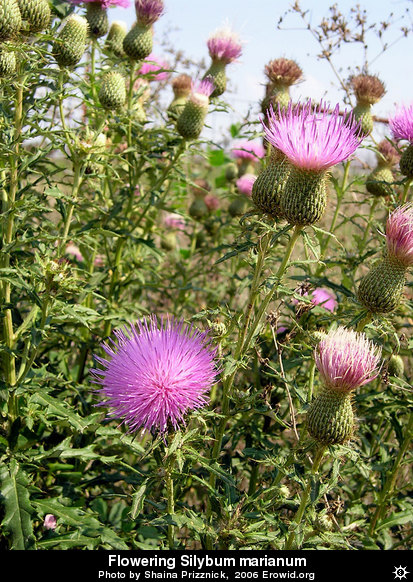
Milk thistle (Latin Name: Silybum Marianum) is a plant native to Europe, where it has a long history of use as a folk remedy for liver and gallbladder disorders. The active part of milk thistle is thought to be silymarin, a flavonoid which is found in the seeds.
Today, milk thistle is the main ingredient in most liver and gallbladder supplements you will find at the health food store. While preliminary studies suggest milk thistle supplements may be beneficial for people with cirrhosis of the liver, the main use is to detoxify the liver and protect from liver damage. Milk thistle is believed to protect the liver against toxicity from acetaminophen (Tylenol), alcohol and other drugs. In Europe, milk thistle is reportedly administered to patients when they are given medications known to cause liver problems. Milk thistle has also been explored for cancer prevention and high cholesterol.
A word of caution: people with allergies to daisies, artichokes, kiwi, common thistle or plants in the aster family may also be allergic to milk thistle. There have been several reports of anaphylactic shock in people who have used milk thistle products and milk thistle may reduce the effectiveness of oral contraceptives.
Sunday, December 16, 2007
Biotin for Healthy Hair and Nails
After having an episode where my fingernails became weak and basically fell off a few years ago, I went to the health food store desperate for some help. What I walked out with was a bottle of Biotin (5000 mcg capsules). I was told to take 1 capsule a day and I faithfully did so. While it took a few months for my fingernails to grow back, when they did they were stronger than ever before.
I had been putting acrylics on my nails for years, because my natural nails were very soft and would constantly tear (this may have caused the issue with the fingernails falling off - that was never confirmed). Since taking the biotin, my nails have been incredibly strong and both my hair and nails have grown faster than before. After having these wonderful results, many friends and family have started supplementing with Biotin - all with amazing results. I now take 5 mg of Biotin daily and since I have learned that my nails get weak again if I don't take it - this is a supplement that I will always take!
Monday, December 10, 2007
Pamper Your Tootsies!
You can re-create a soothing spa treatment at home by giving your feet (or hands) a stone massage with natural essential oils. All the luxurious, soothing relaxation at a fraction of the cost! Feel free to use oils from your cupboard if that's what's available.
Here's how:
1. Choose your stones.
Gather one large smooth and rounded stone, and eight smaller ones to fit between your toes. Gather stones from your garden or use smooth river stones.
2. Choose an oil.
Lavender and chamomile scents are relaxing. Citrus essential oils, as well as juniper and clary sage, are rejuvenating. If you have sore feet, try using lavender, rosemary, or cypress essential oils. Dilute with a carrier oil such as olive oil. Lavender and tea tree oil are safe to use without a carrier oil. Tea tree essential oil is highly antiseptic, anti-fungal, has a crisp, clean scent and may be mixed with other essential oils.
3. Create a relaxing atmosphere.
Light your favorite candle or play relaxing tunes such as nature sounds.
4. Exfoliate.
Gently exfoliate your feet. Underneath those rough spots and calluses is smooth skin that is just waiting to be exposed. Use a foot scrub or a pumice stone. Use the stone firmly but gently. Don't pumice too hard or too frequently as friction is what causes rough skin in the first place. Use the stone once a week maximum. A pumice stone will last for years.
Warm up a pot of water to about 110 degrees Fahrenheit to heat the stones. Do not let the water boil. In a warm towel, take the stones to your designated home spa area. Place them between your toes. You can also use a crock pot to warm the stones for more convenience.
Massage the oils into your feet, making sure to get in between and under the toes and around your ankles as well. Use the large stone to rub the arch and ball of each foot for up to 10 minutes. Feel the tension melt away. If you'd like, you can warm up the stones again. Reflexology has shown that there are pressure points all over your feet that relate to other organs of your body. If you find a sore spot - massage it till you feel a easing of the soreness.
Enjoy improving your physical as well as your emotional health with your own natural home spa treatment. You will have better looking and feeling feet at a fraction of the salon cost.
Sunday, December 2, 2007
Great Alternative Medicine Resource
If you have heard of an alternative medicine term and want some more information - check out this wonderful Alternative Medicine Glossary!
Take some time to explore it - it is a great website for a variety of reasons!


