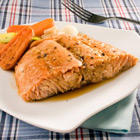
Alzheimer's researchers have long touted fish oil, by pill or diet, as an accessible and inexpensive "weapon" that may delay or prevent getting this debilitating disease. Now, UCLA scientists say they have confirmed that fish oil is indeed a deterrent against Alzheimer's--and they have identified the reasons why.
As reported in the Journal of Neuroscience, Greg Cole, professor of medicine and neurology at the David Geffen School of Medicine at UCLA and associate director of UCLA's Alzheimer Disease Research Center, and his colleagues report that the Omega-3 fatty acid docosahexaenoic acid (DHA) which is found in fish oil increases the production of LR11.
LR11 is a protein that is found at reduced levels in Alzheimer's patients and is known to destroy the protein that forms the "plaques" associated with the disease.
The plaques are deposits of a protein called beta amyloid that is thought to be toxic to neurons in the brain, leading to Alzheimer's. Since having high levels of LR11 prevents the toxic plaques from being made, low levels in patients are believed to be a factor in causing the disease.
Alzheimer's is a debilitating neurodegenerative disease that causes memory loss, dementia, personality change and ultimately death. The national Alzheimer's Association estimates that 5.1 million Americans are currently afflicted with the disease and predicts that the number may increase to between 11 million and 16 million people by the year 2050.
Fish oil and its key ingredient, Omega-3 fatty acids (found in fatty fish like salmon), have been a mainstay of alternative health practitioners for years and have been endorsed by the American Heart Association to reduce the risk of cardiovascular disease.
Fatty acids like DHA are considered "essential" fatty acids because the body cannot make them from other sources and must obtain them through diet.
Years of research have shown that DHA is the most abundant essential fatty acid in the brain, Cole said, and that it is critical to fetal and infant brain development.
Studies have also linked low levels of DHA in the brain to cognitive impairment and have shown that lower levels may increase oxidative stress in the brains of Alzheimer's patients.
Still to be determined, he said, "is what the optimal dose should be. It could be that a smaller amount might be helpful, especially in a place like the south of France, where people are already on a Mediterranean diet."
Here in the United States, though, where fish consumption is not very high, the dose may need to be higher.
Funding for the research was provided by a grant from the National Center for Complementary and Alternative Medicine. The research was initiated with support from the National Institute on Aging.
Welcome to Healthy Living!
Most of us want to live a healthier life, but it is sometimes a daunting task trying to sift through the often-conflicting information we are given, in an effort to find what will work for us. We have all heard the ongoing debate about whether low-carb diets are healthy or bad for us and the varied opinions about which carbs we should be eating. There is the accepted opinion that coffee/caffeine has a harmful effect on your life and then the newer opinion that it is actually beneficial. The same is true for alcohol - red wine to be specific - does it kill brain cells or does is that negated due to the positive, healthy effects it seems to have on the heart? These debates are only the tip of the iceberg . . .
While the previous issues address what we should and shouldn't be eating, there is also the question of what to do if we have developed some ill effects (not feeling well, no energy, weight gain, disease) and want to reverse them. There are so many possible solutions. Do we fast - and if so what kind of fast (juice, water, fruit)? Do we need to detox? If so - how? Herbal cleanses, colonics, saunas, body wraps, sea water baths, Epsom salt baths? What herbs will help heal our bodies and in what quantities? And what about the alternative therapies: massage, Reiki, bio-feedback, hypnotherapy, meditation, light therapy, aromatherapy (to name only a few!)? Which of these would help us in our particular situation?
How to make sense of all this information? We would like to have this site be a place to discuss which things have worked for us (or haven't) and hopefully by sharing our experiences we will be able to help each other wade through all the possibilities and find our own paths to a Healthy Life!
While the previous issues address what we should and shouldn't be eating, there is also the question of what to do if we have developed some ill effects (not feeling well, no energy, weight gain, disease) and want to reverse them. There are so many possible solutions. Do we fast - and if so what kind of fast (juice, water, fruit)? Do we need to detox? If so - how? Herbal cleanses, colonics, saunas, body wraps, sea water baths, Epsom salt baths? What herbs will help heal our bodies and in what quantities? And what about the alternative therapies: massage, Reiki, bio-feedback, hypnotherapy, meditation, light therapy, aromatherapy (to name only a few!)? Which of these would help us in our particular situation?
How to make sense of all this information? We would like to have this site be a place to discuss which things have worked for us (or haven't) and hopefully by sharing our experiences we will be able to help each other wade through all the possibilities and find our own paths to a Healthy Life!
Monday, January 28, 2008
Eat Your Fish - Keep Your Memory
Subscribe to:
Post Comments (Atom)


No comments:
Post a Comment